The dreaded basement
Most people have been meaning to deal with it for years
Almost everybody I talk to says a version of the same sentence. They have been meaning to get to the basement for a while now. Two years. Five. Since the move.
It is almost never laziness. It is that the basement is where the hard things went. The bins of school papers and baby clothes. The boxes nobody opened after the move. A tote of somebody's things you are not ready to go through. The someday project you still mean to finish. Sorting it means handling it, and handling it takes an afternoon you do not have and a mood you are not in.
So it stays on the floor in a pile that has a shape now, and every time you go down for a lightbulb you look at it and close the door on the way back up.
Here is the part worth saying out loud: there is nothing wrong with you and there is nothing unusual about your basement. I see this exact room every week. You do not have to sort a single box before I get there, and you do not have to tidy up for the video call. The custom wood shelving goes in first. The sorting gets a lot easier after that, because for the first time everything has somewhere to go.
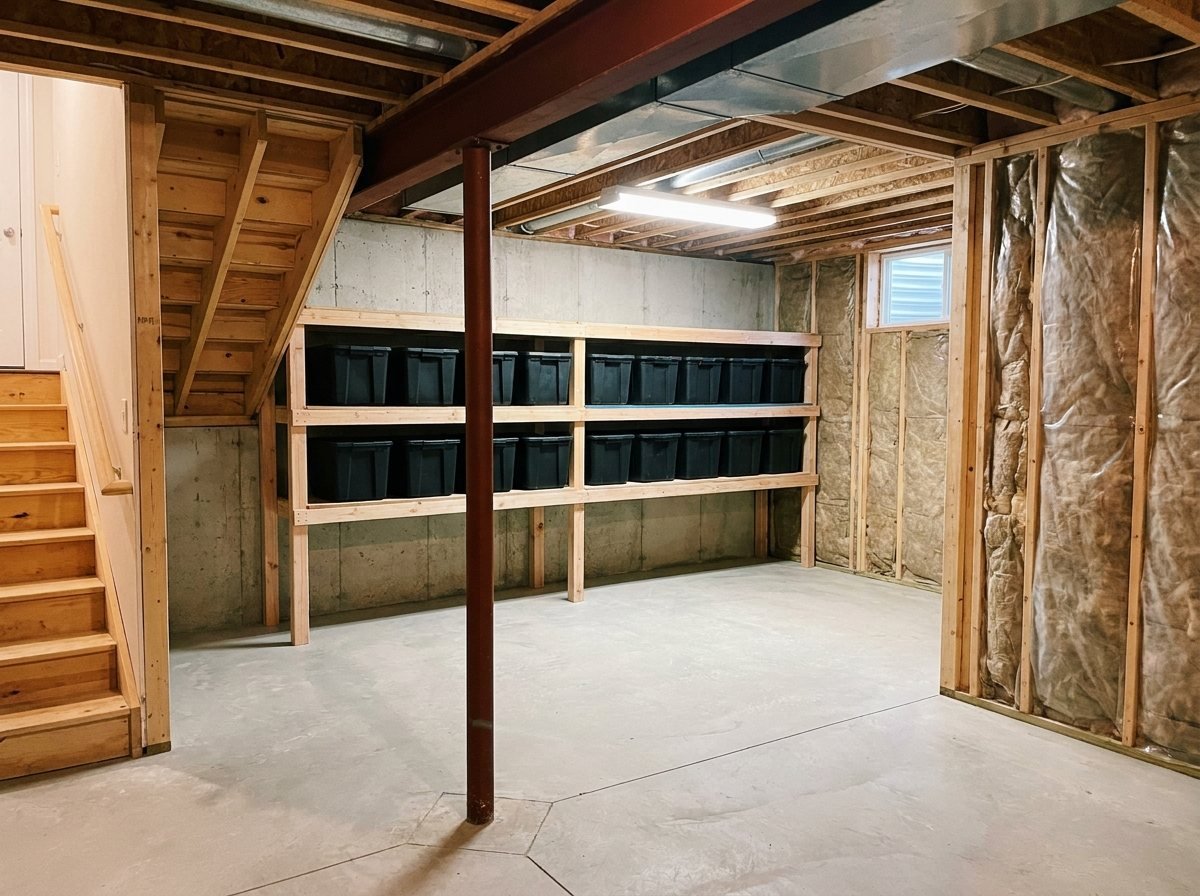
Same wall, same afternoon
A real basement in Munster, before and after
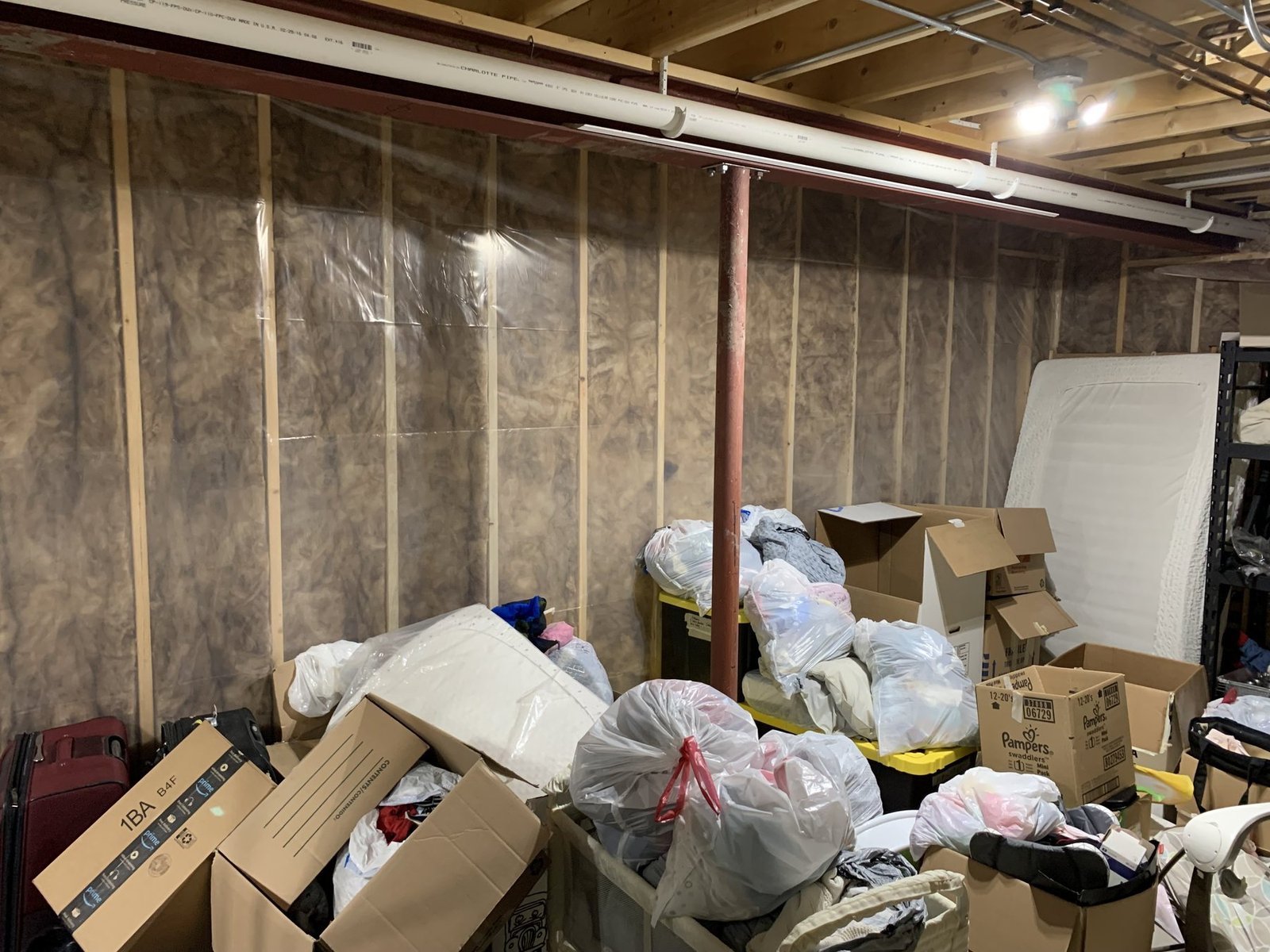
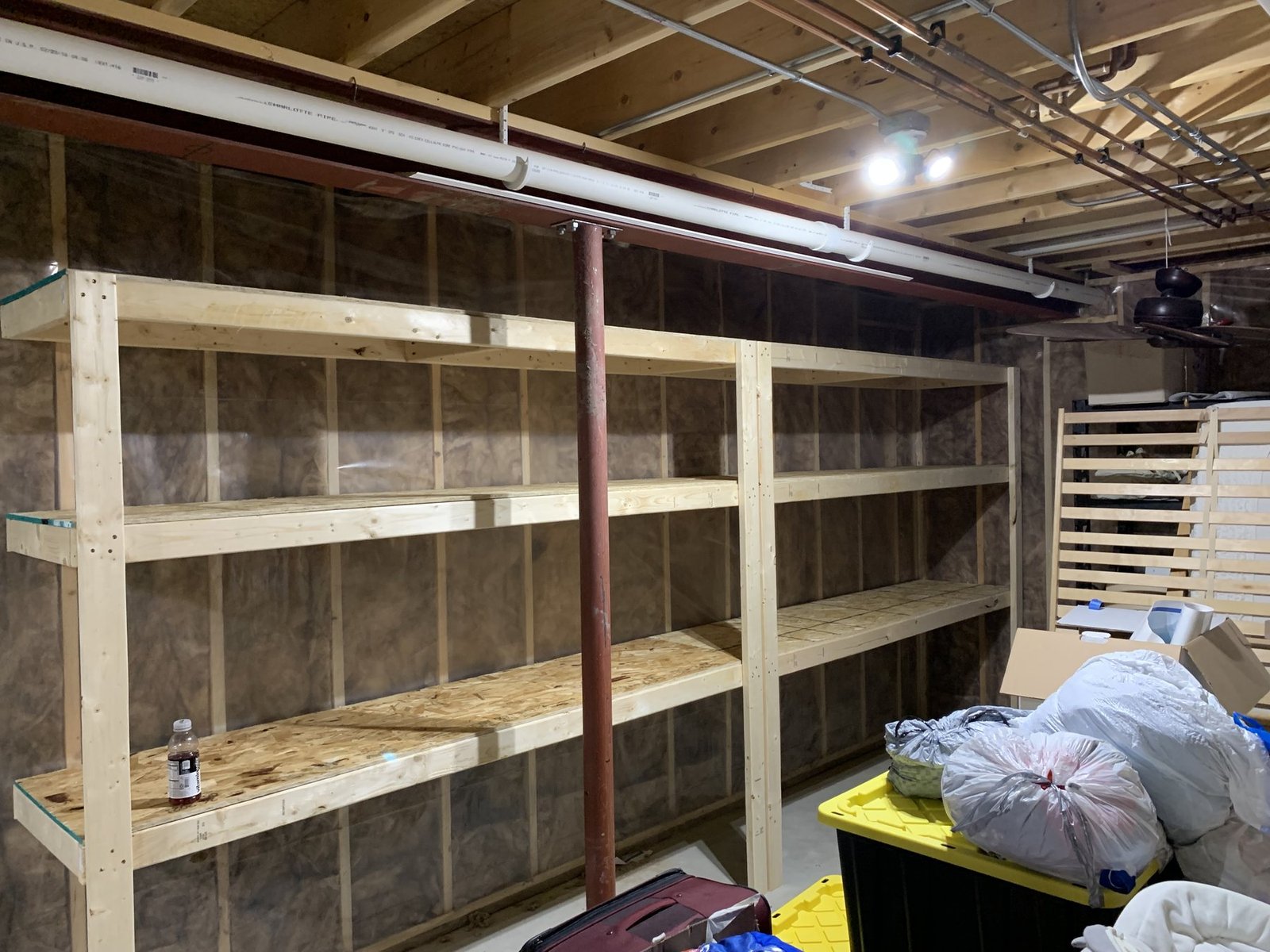 BeforeAfter
Two photos of one wall in one house, taken the day I built it. Drag the handle across.
The first job is getting everything up off the floor
Basements around here take on a little water sometimes. Usually not a flood. A wet spring, a heavy storm, a sump that runs all night, a water heater that lets go on a Tuesday, and a thin line of water runs along the base of the wall and finds the low spot in the slab.
Cardboard is the thing that gets ruined. A box sitting flat on concrete pulls moisture up through the bottom even when there is no water to see, because the slab is cool and it sweats. The box goes soft, the corners give out, and the next time you pick it up the bottom stays on the floor. Whatever was in it is the part that actually hurts.
So the first thing shelving does in a basement has very little to do with looking tidy. It gets everything up. A few inches of air under the bottom deck is the whole difference between a damp week in April and a box of photographs you cannot replace.
And while we are being honest, here is something I will tell you even though I do not sell them: in a basement, sealed plastic bins beat cardboard boxes every single time. They do not wick, they do not collapse, they stack square on a deck, and you can see what is in them without opening four of them first. If you buy one thing before I show up, buy bins.
- Photos, paperwork and anything you would be sick to lose goes in a sealed bin on a shelf, never a box on the slab.
- Keep the floor under the bottom deck clear so water has somewhere to go and air has somewhere to move.
- Label the end of the bin that faces out, not the lid. You will be glad in December.
- A dehumidifier helps the room, but it will not save a box that is sitting in a quarter inch of water.
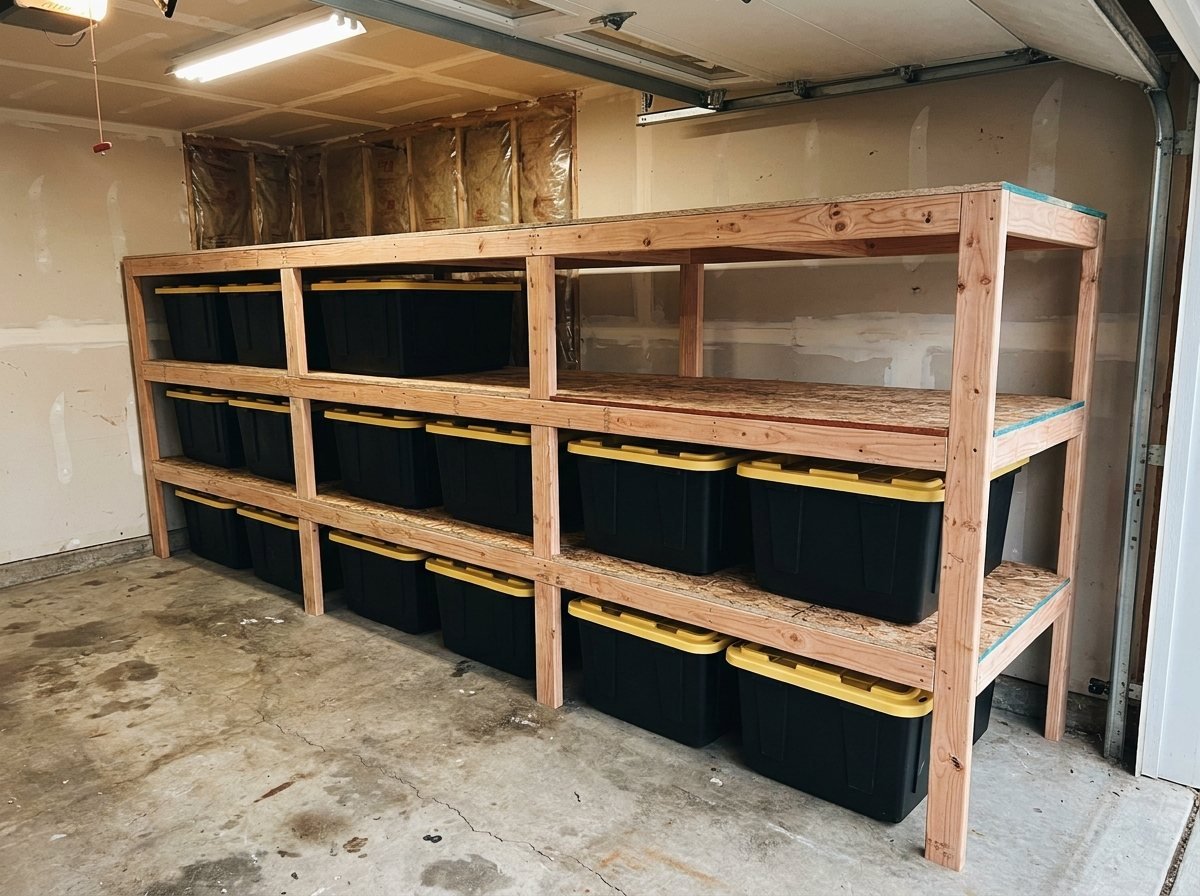
The honest part
Elevation matters more than what the shelf is made of
If you have been reading up on basement shelving, you have probably landed on plastic or coated steel, and the reason given is always moisture. That is fair and I am not going to pretend otherwise. Plastic and metal shrug off damp better than wood does. If a shelf is genuinely going to stand in water, it should not be wood.
But moisture resistance is the only problem those racks solve, and it is not the problem that is costing you the basement. What is costing you the basement is that a 4 foot plastic rack does not fit your wall, sags in the middle of its own span once it is loaded, will not take a large tote two across, and quits about 2 feet short of your ceiling. So you buy three of them, they sit at three different heights, and there is still a pile on the floor.
Getting your things up off the slab is what protects them. Building to the wall you actually have is what gives you the room back. A wood frame anchored into the studs does both at once, and it puts the bottom deck up where the water is not.
Before I cut anything
In a basement, the ceiling and the mechanicals set the shelf heights
Nothing down there is a clean rectangle. That is the whole reason a catalog shelf never quite works in a basement.
The joists set the top
Your shelf height is not a number off a box. It is whatever the underside of the joists gives me, minus the room you need to lift a loaded tote onto the top deck without fighting it.
The ductwork comes first
A trunk line crossing the room can take a foot of height out of one bay. I drop that bay, hold the rest at full height, and the run still reads as one clean wall.
The lally column
The steel post in the middle of the floor is holding your house up. Nothing gets fastened to it and nothing crowds it. I build up to it and leave you the walk around.
The sump and the mechanicals
The sump pit keeps a clear lid, the furnace and water heater keep their service room, and the electrical panel stays open and reachable. Those are fixed, so the shelving is drawn around them.
Tiers sized to your bins
Memory bins and holiday totes are not the same height. I measure the ones you already own and set each tier to them, so nothing has to go in sideways or ride on top of another lid.
The top 2 feet of wall
Most basement walls give up their top 2 feet to nothing at all. The things you touch once a year belong up there, and that is usually where your floor space comes back from.
The Region Build
How I build them, step by step
This is the same system on every job. It is the one the internet tells you to build, and it is the reason these shelves do not sag.
Ledgers
A 2x4 ledger runs the length of the wall and gets anchored into the studs, not the drywall.
Doubled ledgers
Where the load calls for it, the ledger is doubled up so the back edge of every shelf is carrying on two members.
Front uprights
Full height 2x4 uprights carry the front edge all the way to the floor, so nothing is hanging off the wall alone.
Extended frame
The frame is squared and extended to the depth your bins actually need, not to a catalog depth.
Cross supports
Cross members tie front to back on every level. This is what kills the sag before it starts.
Plywood decks
Plywood decks drop in on top, screwed down flat. Now it is a shelf you can stand on.
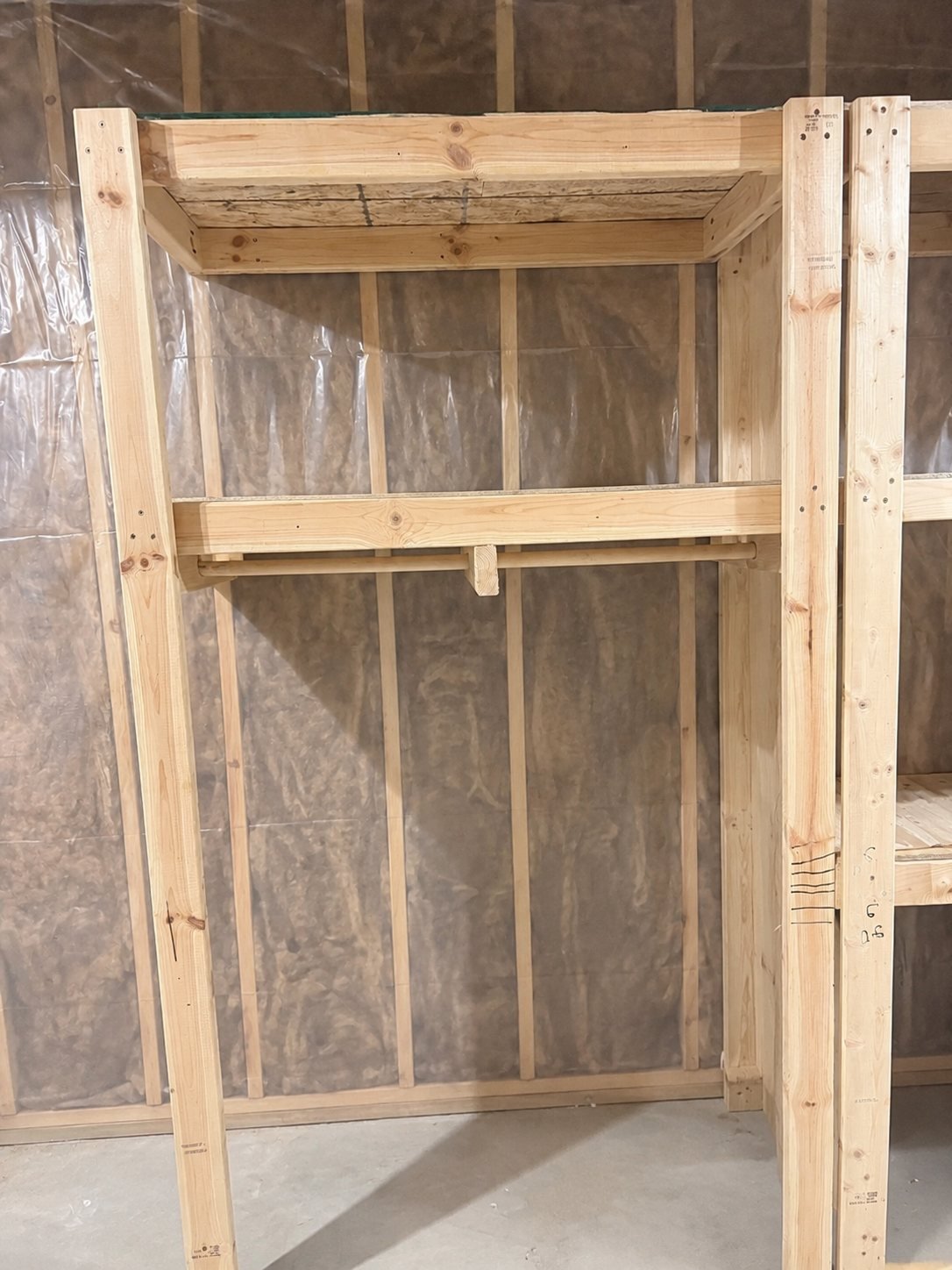
Why it does not sag
Anchored into the studs, carried down to the floor
The back edge of every shelf rides on a 2x4 ledger lagged into the wall studs. Not drywall anchors, not the poly wrapped insulation, the framing behind it. Where a bay is going to carry real weight, the ledger gets doubled so the load is sitting on two members instead of one.
The front edge is carried by full height 2x4 uprights that run all the way down to the slab, so no part of the shelf is hanging off the wall on its own. Cross supports tie front to back under every level, and the plywood decks drop on top and get screwed down flat. That is what kills the sag before it ever starts.
It is the same system I build in the garage, with the basement details changed: the bottom deck held up off the slab, the heights taken from the joists, and the whole run drawn around the column, the ducts and the pit. If you want the garage version of this, here is custom garage shelving.
How it works
Get your price on a video call or an onsite visit
Your choice, either way. Text me and I will confirm a time, usually the same day. Three steps, about ten minutes.
Text me
Text me your town, what you want shelves in, and a couple of day and time windows that work. Texting is the fastest way to get hold of me.
Video call or I come out
Your choice. Most people do a short video call from their phone. If you would rather I came and stood in the space, I will do that too.
Get your price
I price the job right there, on the call or in your driveway. No waiting a week for a proposal.
Straight answers
Basement shelving questions I get asked
Is wood shelving alright in a basement that gets a little water?
In the great majority of basements around here, yes, because the wood is not sitting in the water. The bottom deck is held up off the slab, the frame is anchored to the wall, and air moves under and behind it. If your basement genuinely takes standing water on a regular basis, tell me on the call and I will say so honestly, and we will talk about how high the bottom deck needs to start.
Should I use plastic bins or are cardboard boxes fine?
Use sealed plastic bins. I do not sell them and I still tell everybody the same thing. Cardboard on a basement shelf is better than cardboard on the floor, but cardboard pulls damp out of the air, the corners give out under weight, and a stack of boxes is the one thing that will not stack square. Bins stack, seal and let you see what is inside.
My basement ceiling is low. Is there even room for shelving?
Almost always. Low headroom changes the tier spacing, not whether it can be done. I take the height from the underside of the joists, leave the clearance you need to lift a loaded tote onto the top deck, and set the tiers to your bins from there. Low ceilings usually mean one fewer tier and slightly deeper decks, which is a trade most people are happy with.
Can you build around the lally column, the ductwork and the sump?
Yes, and that is most of the reason people go custom in a basement instead of buying a rack. The steel column is structural so nothing fastens to it and nothing blocks the path around it. Ducts and the main trunk line get a lower bay under them. The sump pit keeps a clear lid, and the furnace, water heater and panel keep their space.
Do I have to clean the basement out before you come?
No. Not for the video call and not for the install. The call is 10 minutes and I have seen every version of this room, so point the camera at the pile and do not think twice about it. On install day I just need to be able to reach the wall, so we slide things toward the middle and put them back on the shelves at the end of the day.
How deep should basement shelves be?
The bins decide it. A large tote runs roughly 18 to 20 inches deep, so a deck in that range lets bins sit all the way back without hanging over the front edge. If you are storing coolers, camping gear and holiday totes, deeper earns its keep. If it is mostly paint, tools and paper bins, shallower keeps more of the floor open. We settle it on the call.
What does basement shelving cost?
It comes down to how much wall you are covering, how deep the decks need to be, how many tiers fit under your joists, and how much building around the column and the mechanicals the layout takes. That is exactly why the estimate is a short video call instead of a price list. Show me the wall and you get a real number on the call, not a range that means nothing until somebody comes out. Book the call and we will go through it.
Do you build garage shelving too?
I do. Garages are the other half of the work, and it is the same framing built for a different room. Have a look at the page on custom garage shelving, or just tell me on the call that you want both and we will price them together.
Service area
Basement shelving across The Region
Pick your town for the local detail, or just book the call and tell me where you are.
Related reading
More on this, in plain English
The questions I get asked most, written down so you can read them before you ever call me.
How to Keep Basement Storage Off the Floor
How to keep basement storage off the floor in a basement that takes water: why cardboard on concrete fails, why sealed bins win, and why elevation bea.
Read itHow to Clear Out the Basement You Have Been Avoiding
A no shame method for clearing out a basement you have avoided for years: short sessions, four boxes, sentimental items last, and storage decided last.
Read itWhat Shelf Size Fits Standard Storage Totes?
A large storage tote needs about 19 to 20 inches of shelf depth and 18 inches of clear height between tiers. How to size a shelf to the bins you own.
Read itLocal detail
Munster basements get their own page.
Basement Storage Shelving in Munster, IN
Custom wood basement shelving for Munster, IN homes. Built around the steel column, the low ducts and the poly wrapped walls, and anchored into real studs.
See the Munster pageEverywhere else in The Region
Highland, Dyer, Schererville, Griffith, St. John, Crown Point, Hammond and Merrillville all have their own page too.
All service areasBook it
Let me price your basement on a quick video call
Pick a couple of windows that work, walk me around the basement on your phone, and you will have a real number before we hang up. Nothing to tidy first.